Dry needling helps reduce chronic muscle pain by releasing trigger points, improving circulation, and restoring normal muscle activation during rehabilitation.
Chronic pain is often driven by overactive motor points inside tight muscle tissue. Dry needling reduces abnormal muscle contraction, improves local circulation, and restores joint motion when paired with structured strength work. It is most effective for athletes, veterans, and active adults dealing with recurring tension or injury that does not resolve with stretching alone.
Searches for dry needling near me reflect demand for anatomy-based care rather than passive treatment cycles.
Dry needling targets myofascial trigger points—localized areas of excessive motor end plate activity inside skeletal muscle.
These dysfunctional regions develop when muscle fibers remain in a shortened, overactive state and fail to return to baseline tone.
Trigger points may:
For many patients, this presents as deep, stubborn tightness that does not improve with stretching alone. In athletes and active adults, delayed stabilizer activation can reduce force output and increase joint stress under load.
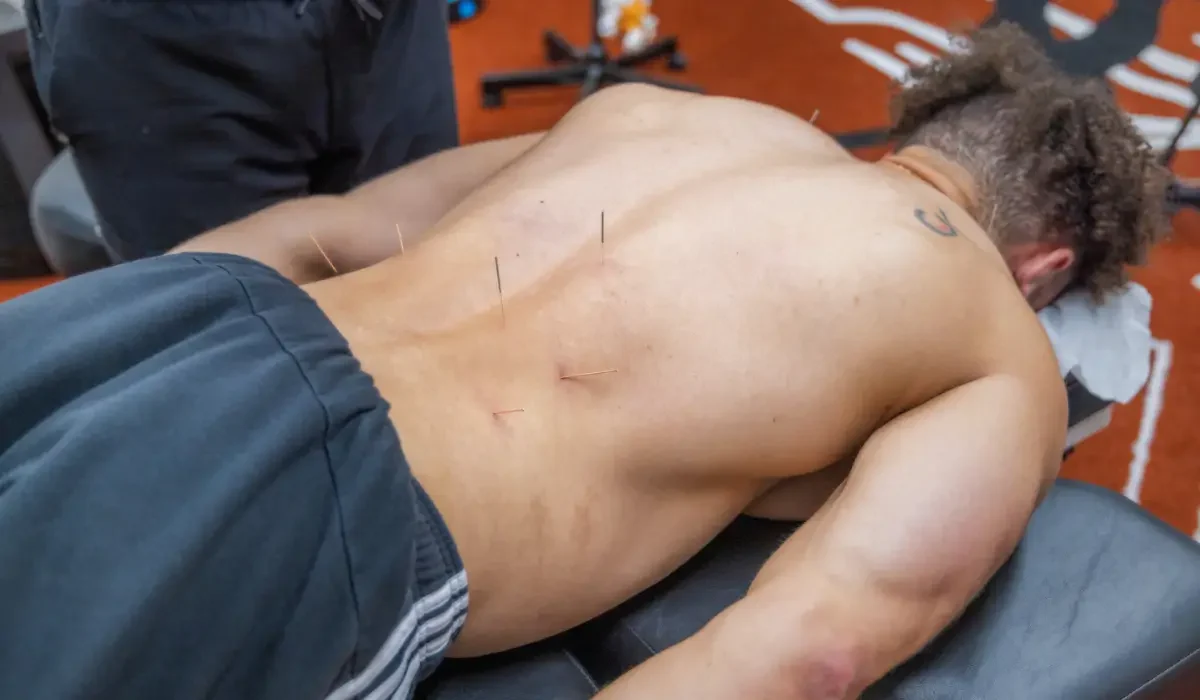
Precise needle placement often produces a localized twitch response. Most patients describe this as a brief contraction or pressure sensation rather than sharp pain.
Electromyography studies demonstrate that trigger point stimulation can reduce spontaneous electrical activity in dysfunctional muscle fibers. This helps normalize neuromuscular signaling and decrease excessive contraction.
Clinical research also shows short-term improvements in range of motion and pain reduction in conditions such as chronic neck and shoulder dysfunction when trigger points are properly addressed.
Improved microcirculation following stimulation increases oxygen supply and supports removal of metabolic byproducts that contribute to fatigue and stiffness.
Unlike passive massage, dry needling directly affects motor control and muscle activation timing. The intervention is recognized within modern rehabilitation practice, including standards outlined by the American Physical Therapy Association.
It does not:
It works by resetting dysfunctional muscle behavior.
Inside our Sports Medicine Acupuncture & Dry-Needling program, needle intervention is immediately reinforced with controlled mobility drills and progressive loading.
The objective is not temporary release. The objective is durable mechanical correction.

Chronic tension reflects compensation.
When joint mobility decreases, surrounding muscles increase resting tone to stabilize the area. Over time, this protective contraction disrupts normal length–tension balance and reduces mechanical efficiency.
Active trigger points may:
Dry needling reduces excessive motor unit activity within tight fibers, helping restore more efficient neuromuscular signaling and tissue perfusion.
Clinical evidence supports trigger point therapy for improving pain sensitivity and short-term mobility in common neck and shoulder conditions.
Patients seeking muscle pain relief Naperville commonly present with:
Temporary release alone does not correct the pattern. Structured strength progression under the Resilient Method stabilizes results and improves long-term load tolerance.
After an injury, your body tightens muscles around the area to protect it. When that tightness stays too long, it limits normal movement and slows progress.
Sports injury dry needling helps calm overactive muscles and improve how they work during recovery. It reduces unnecessary muscle tension that can block smooth, controlled movement.
Research shows it can help:
Many athletes notice they move more freely once tight, guarded muscles are no longer limiting them.
Veterans dealing with long-standing orthopedic strain patterns can access focused support within veteran performance care.
Recovery is defined by restored movement capacity—not temporary comfort.
When one joint loses motion, nearby areas compensate.
Over time, compensation changes how force moves through the body. This increases fatigue and raises the risk of repeated strain.
Dry needling helps release shortened muscle fibers that block normal joint movement. When restriction decreases, joints can move with less resistance and better control.
Improved movement does more than increase flexibility. It can:
Patients pursuing dry needling Naperville often notice improved motion shortly after treatment. Lasting results depend on reinforcing that range with controlled strengthening.
How We Track Change
During a structured new client evaluation, we measure baseline mobility and reassess after treatment cycles.
Follow-up assessments confirm measurable changes in mobility and movement control. Objective tracking prevents guesswork and improves accountability.
Restored motion must be supported by strength.
Range that is not reinforced will regress.
Chronic musculoskeletal pain affects nearly 20% of adults in the United States. Many rely on anti-inflammatory medication or injections that suppress symptoms but do not restore mechanical balance.
Dry needling offers an evidence-based alternative that addresses muscle dysfunction directly.
Peer-reviewed research, including systematic reviews published in medical journals such as PubMed Central, supports its use for:
Our approach integrates principles seen in chronic pain acupuncture while maintaining strict biomechanical assessment standards.
Safety is prioritized. Mild soreness can occur within 24–48 hours as tissue adapts. Serious complications are rare when performed by trained clinicians.
Clinical questions can be addressed directly at (708) 752-3332.
Pain often returns when the body is not strong enough to handle stress.
Reducing muscle tightness creates opportunity. It does not create durability.
Dry needling helps reset overactive tissue so movement can be retrained correctly. The real goal is preparing joints, muscles, and connective tissue to handle real-world demand.
What Long-Term Progress Requires
Resilient Acupuncture + Mobility needle therapy is part of a structured progression:
Building strength at the outer limits of motion improves joint stability and reduces repeated strain. Stronger connective tissue also improves tolerance to sudden force changes, such as cutting, lifting, or rapid direction shifts.
Passive care alone does not prepare the body for these demands.
Clinical Direction
Aaron Avila, Certified Sports Medicine Acupuncturist and Functional Range Systems Practitioner®, designs care around measurable movement standards.
As a veteran and former athlete, he understands that recovery must prepare the body for load, speed, and unpredictability—not just reduce discomfort.
The objective is physical readiness that holds under stress.
Chronic pain is not random. It develops when the body is asked to handle more stress than it is prepared for.
Reducing discomfort alone is not enough. Long-term improvement requires correcting movement patterns and building strength that holds under real demand.
Resilient Acupuncture + Mobility dry needling is delivered as part of our structured Sports Medicine Acupuncture and guided by the Resilient Method. Treatment begins with precise muscle intervention and progresses into controlled mobility and strength development.
This integrated approach supports sustainable recovery for professionals, veterans, and athletes who expect measurable results.
The goal is not temporary relief.
The goal is resilient movement that performs under pressure.

About the Author
This article was written by the clinical team at Resilient Acupuncture + Mobility, led by Aaron Avila — a certified Sports Medicine Acupuncturist, veteran, and Functional Range Systems® practitioner. With deep expertise in mobility restoration, pain relief, and performance care, the team integrates hands-on experience with advanced assessment methods to support athletes, active adults, and chronic pain clients across Naperville and beyond. Every piece of content we share is rooted in real practice and designed to empower long-term movement health.